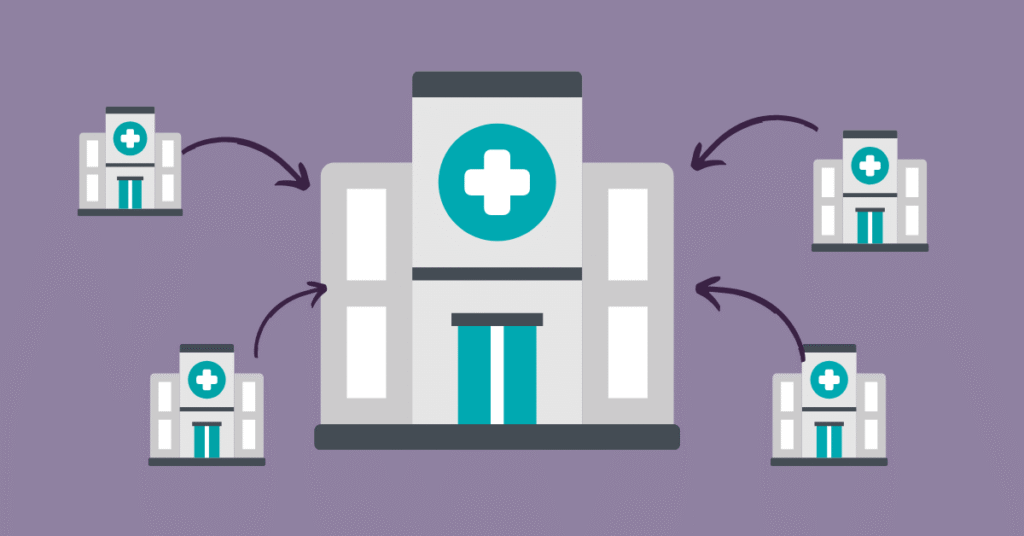
We have been told for decades that hospital mergers are good for the consumer. That larger systems can leverage their scale to negotiate better prices and reimbursements, then pass those savings along to the consumer. A recent report from KFF Health News highlights that in fact, the opposite is true. With less competition, medical systems have less incentive to price their services competitively. In fact, we keep seeing that healthcare costs rise when competition decreases.
By way of example, KFF Health News reported on two hospitals systems in North Carolina. Investigators found that the same knee replacement priced at roughly $16,000 at one hospital and around $40,000 at another, under the same insurance plan. The difference wasn’t the surgery, or even the insurer. It was the market.
In 1998, North Carolina regulators approved a merger between Asheville’s two acute-care hospitals. The deal created Mission Hospital. Regulators saw the risk coming, so they attached limits on Mission’s spending and profit margins.
Those limits held for about two decades. Then, in 2015, Mission lobbied the state to drop them. Three years later, HCA Healthcare bought Mission Health outright. HCA is the country’s largest for-profit hospital corporation. A researcher who tracked the deal called it “a prepackaged monopoly” for the nation’s biggest hospital chain.
The pricing data backs that up. Mission charged more than four times as much for a breast biopsy as a nearby competitor. For a hernia repair, it charged nearly twice as much.
Less Competition, Fewer Checks on Care
A monopoly doesn’t just remove a hospital’s incentive to keep prices in check. It removes the incentive to keep quality up, too. With no alternative for patients to turn to, a hospital under less competitive pressure has less reason to fix what’s broken.
Mission Hospital’s own record shows what that looks like. State health inspectors issued three “immediate jeopardy” findings against the hospital since 2024. Regulators reserve that designation for problems that put patients at imminent risk of serious injury or death.
The most recent finding involved an 88-year-old woman recovering from hip surgery. She went a night without a blood transfusion she needed, and died. A local watchdog group formed because of what its founder called “terrible things” happening at the hospital, tracing them to severe staff cuts and departing physicians.