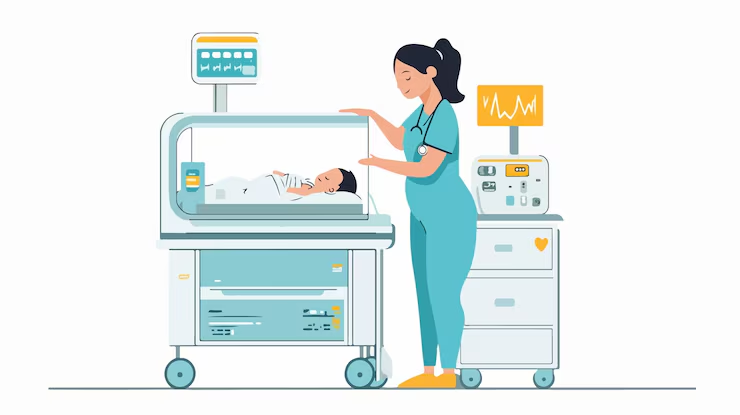
What is a parent supposed to do when their child falls suddenly, and gravely, ill? Not every emergency room is equipped to treat pediatric emergencies; they stabilize the child as well as they can, then transport them to a facility that can handle critically ill kids. Sometimes that’s 5 miles away; sometimes that’s 100+ miles away. And those distances are growing greater as hospitals tighten their belts. According to a recent KFF Health News report, pediatric intensive care units are disappearing across the country.
Community Medical Center in Missoula, Montana, ended its pediatric intensive care services in October. It is not alone. In the past year, hospitals have also closed these units in Oregon and Missouri. In addition, overnight children’s wings have shuttered in Illinois and California. The decline began years ago. For example, a recent analysis found that hospitals with pediatric inpatient units fell by nearly 30% between 2008 and 2022, from 1,749 to 1,226. As a result, three-quarters of hospitals now have no pediatric inpatient services at all.
Hospitals point to a few reasons. First, kids rarely need intensive care, so patient volumes stay low. Second, pediatric subspecialists are in short supply. Hospitals also tend to receive less payment for treating children than adults. One pediatric critical care doctor called the decision “a spreadsheet issue.”
Missoula is merely an example that fits that pattern. The hospital has not recruited a local pediatric critical care doctor since the last one retired eight years ago. Instead, specialists flew in on rotation, and the unit saw about two intensive care patients a month. The closure will affect roughly 25 patients a year.
Medicaid adds pressure. About half of the nation’s kids rely on Medicaid or the Children’s Health Insurance Program. Medicaid cuts reduce reimbursement rates, hospital revenue, and compensation for pediatricians. Maybe instead of a spreadsheet issue it’s a value proposition? Hospital systems’ spreadsheets versus child, family, and societal welfare.
Longer Trips Raise the Stakes for Sick Children
Closures do not end care, though. They move it. And create significant strain on the remaining care centers. Missoula’s hospital will still stabilize the sickest children, then send them elsewhere. The next-closest unit in Montana sits about 150 miles away in Kalispell. In fact, one critical care physician pointed out that some families now live a flight or an eight-hour drive from the nearest children’s hospital.
Meanwhile, regional hubs face strain, especially if there is a spike in demand. One such spoke occurred in 2022: children’s hospitals filled up, and small community emergency departments called 10, 15, or even 20 hospitals to find one that would accept a patient. Researchers expect that scramble to return. This is not the norm, but we the episodes of increased demand will be felt more acutely as pediatric care gets further reduced.
Washington has seen a version of this shift. In June 2025, Valley Medical Center in Renton closed its inpatient pediatrics unit. Valley’s own website had described it as the only inpatient pediatrics unit between Seattle and Tacoma. By then, inpatient volume had fallen to an average of four patients a day, and Valley cited lost state and federal funding. Now, it relies on regional children’s hospitals, to which it sends its sick kids.
A standard of care applies the moment a sick child arrives, including while staff wait on a transfer. Did the emergency team recognize how sick the child was? Did treatment start right away? How quickly did the transfer happen? When emergency departments search for open beds, every hour counts for a child in crisis.
Delays and missed warning signs can lead to a medical malpractice claim. For example, a missed or delayed diagnosis in a small community hospital can carry devastating consequences. Consequently, families in Washington may face longer trips to care as units like Valley’s close.
One researcher said children’s critical care is more of a national necessity than a typical good. The question now is who carries the risk when it disappears. A spreadsheet can show low patient volume. Can it show what a 150-mile trip costs a child having a seizure?